
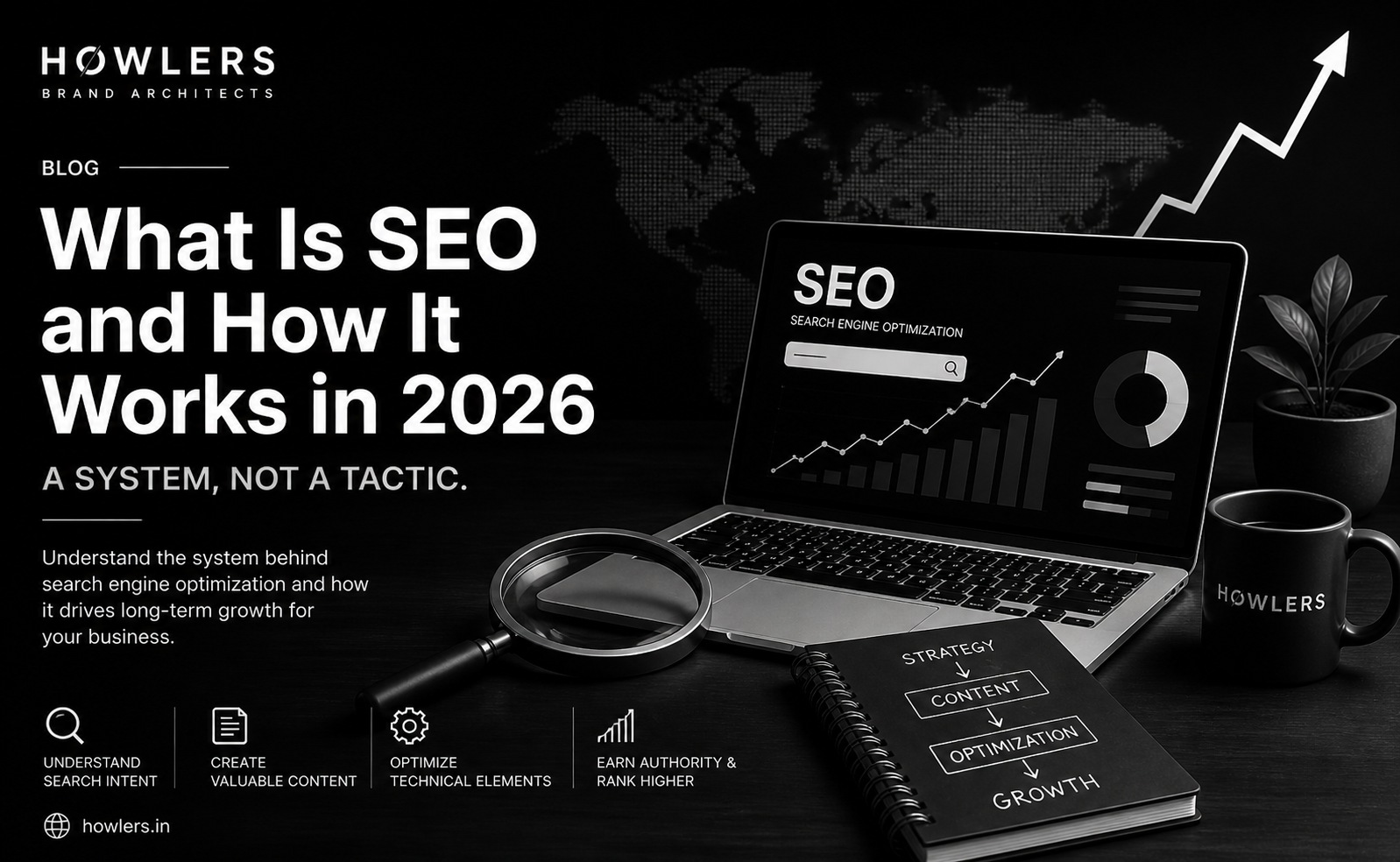
What Is SEO and How It Works in 2026 (A System, Not a Tactic)
Digital marketing is evolving fast, but one channel continues to dominate long-term growth: search.
If you’re trying to understand what is SEO and how it works, you’re not alone. Most businesses know they need search visibility, but very few understand how SEO actually drives consistent growth.
Industry data suggests that over 50–60% of all website traffic globally comes from search engines, with Google alone accounting for the majority of that volume. That means more than half of your potential customers are actively searching not scrolling, not browsing searching.
Yet most businesses still misunderstand SEO.
They treat it as:
- Keywords
- Blog posts
- Rankings
Instead of what it actually is: A structured system for capturing demand, building trust, and driving consistent growth.
If you want to understand what SEO is and how it actually works in 2026 you need to move beyond tactics.
Table of Contents
ToggleWhat Is SEO (Search Engine Optimization) and How It Works (Step-by-Step) ?
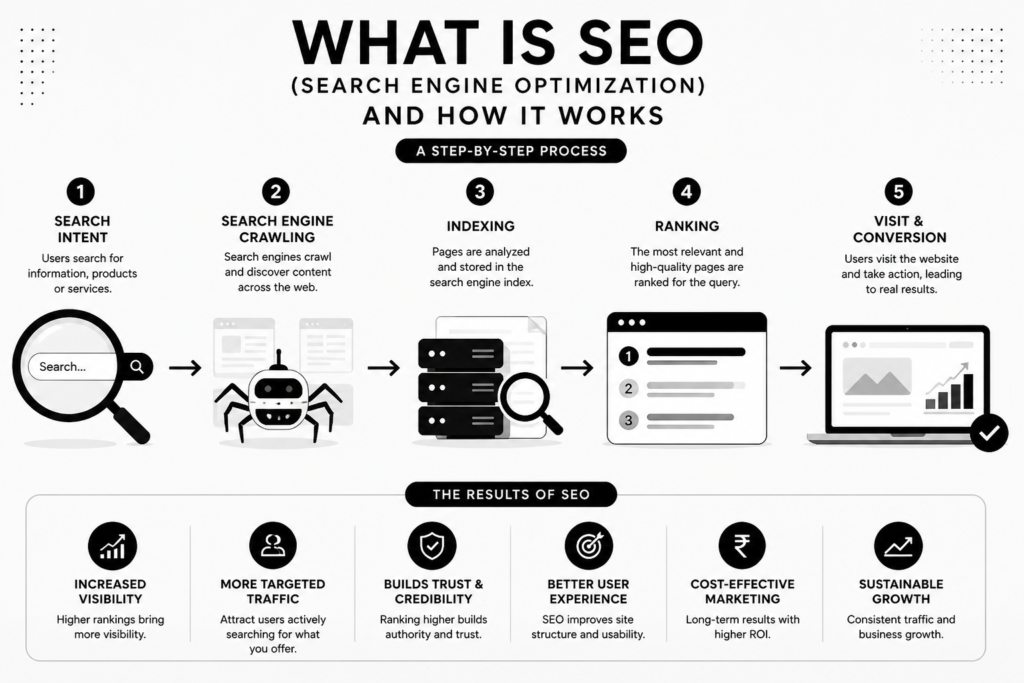
SEO (Search Engine Optimization) is the process of making your business discoverable when people search for solutions you offer.
But that definition is incomplete.
SEO is not just about ranking higher.
It is about:
- Capturing existing demand
- Matching user intent
- Converting traffic into outcomes
A more accurate way to understand SEO:
SEO is a demand-capture system that connects your business to high-intent users at the exact moment they are searching.
This is what makes SEO fundamentally different from most marketing channels.
Unlike ads or social media, SEO does not interrupt attention it aligns with it.
Why SEO Matters More in 2026
Search behavior is not declining. It is expanding.
Google processes approximately 14–16.5 billion searches per day, translating to trillions of searches annually. At the same time:
- Around 70–75% of searches now happen on mobile devices
- Users are shifting toward conversational, multi-query searches
- AI-driven search experiences are increasing
Despite new platforms, one thing remains consistent:
People still search before they decide.
In fact, research shows that:
- Around 60% of consumers research online before purchasing
- Over 70% of users trust organic results more than paid ads
SEO sits directly in this decision-making moment.
How SEO Works (The Reality Most Guides Skip)
Most explanations make SEO look complicated. In reality, SEO works through a simple but structured system:
1. Search Intent (The Foundation)
Every search starts with intent.
Users are looking for:
- Information
- Solutions
- Comparisons
- Decisions
If your content does not match intent, it will not rank regardless of keywords.
2. Content Alignment (What You Publish)
Search engines prioritize content that:
- Answers the query clearly
- Matches user expectations
- Provides depth and relevance
This is why random blog posting fails.
SEO content must be:
- Structured
- Purpose-driven
- Aligned to search behavior
3. Technical Accessibility (Can Google Understand You?)
Before ranking your content, search engines need to:
- Crawl your site
- Index your pages
- Understand your structure
Without proper technical SEO:
- Pages won’t rank
- Content won’t be discovered
4. Authority & Trust Signals
Search engines evaluate:
- Backlinks (other sites referencing you)
- Content depth
- Consistency
This is how trust is built over time.
SEO is not instant because trust is not instant.
5. User Experience & Conversion
Even if you rank, results depend on:
- Page clarity
- Load speed
- Messaging
- Structure
Most websites convert only 2–5% of organic traffic, which means:
👉 Traffic alone does not create growth
👉 Conversion systems complete the process
The SEO System (How It Actually Drives Growth)
SEO is not one activity. It is a connected system.
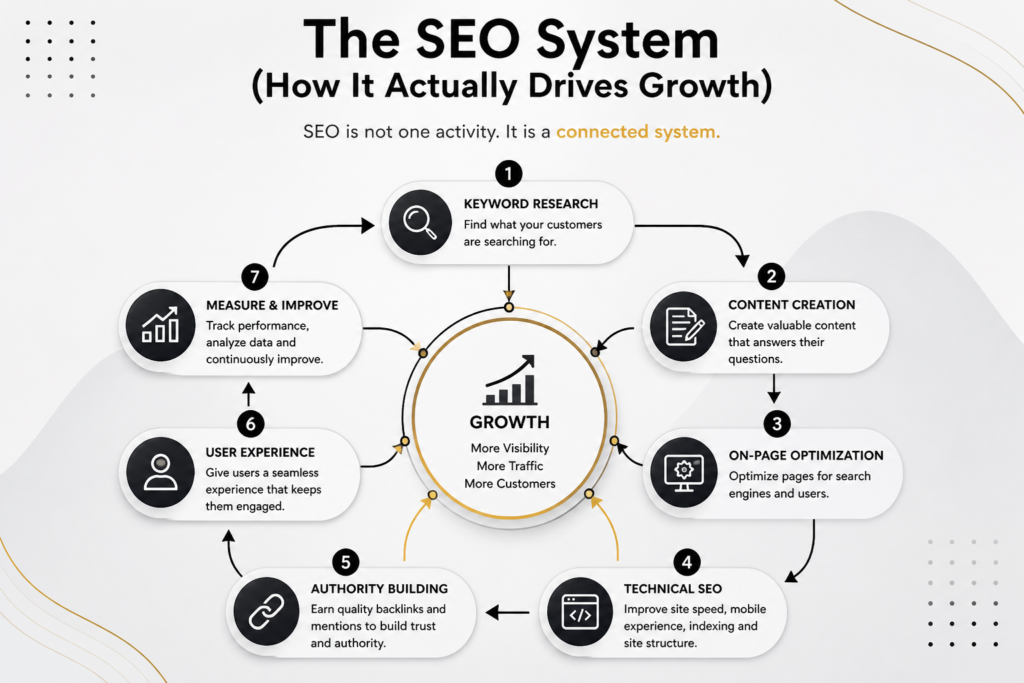
A simplified flow:
Search → Click → Experience → Trust → Action
Let’s break it down:
- Search: User has intent
- Click: Your page appears relevant
- Experience: They land on your website
- Trust: Your content builds confidence
- Action: They convert
When any stage breaks, SEO underperforms.
Organic vs Paid: What the Data Shows

Search results are not evenly distributed.
- Organic results capture roughly 70–80% of total clicks
- Paid ads typically capture 10–20%
- The top organic result alone can get 30–40% of clicks
This tells you something critical: SEO owns attention. Ads rent it. This is why SEO becomes more valuable over time.
How Long Does SEO Take to Work?
SEO is not instant and that is by design.
Typical timelines:
- 3–6 months: Initial traction (indexing, early rankings)
- 6–12 months: Meaningful growth and consistent traffic
In competitive markets, timelines can extend further.
SEO compounds.
The longer you invest correctly, the stronger the returns.
SEO ROI vs Paid Ads
One of the biggest differences between SEO and paid marketing is economics.
- SEO ROI is often estimated between 550–750% over time
- Paid ads typically average closer to ~200% ROI
Why?
Because:
- SEO traffic continues without ongoing cost
- Paid traffic stops the moment you stop spending
This is why SEO is not a tactic it is an asset.
The Shift: SEO in an AI-Driven World

SEO is changing, but not disappearing.
Key shifts:
- AI-generated answers and zero-click searches are rising
- Some estimates suggest 25–30% of searches end without a click
- This could increase significantly in the coming years
What does this mean?
SEO is no longer just about ranking.
It is about:
- Visibility across platforms
- Structured answers
- Authority positioning
Why Most Businesses Fail at SEO
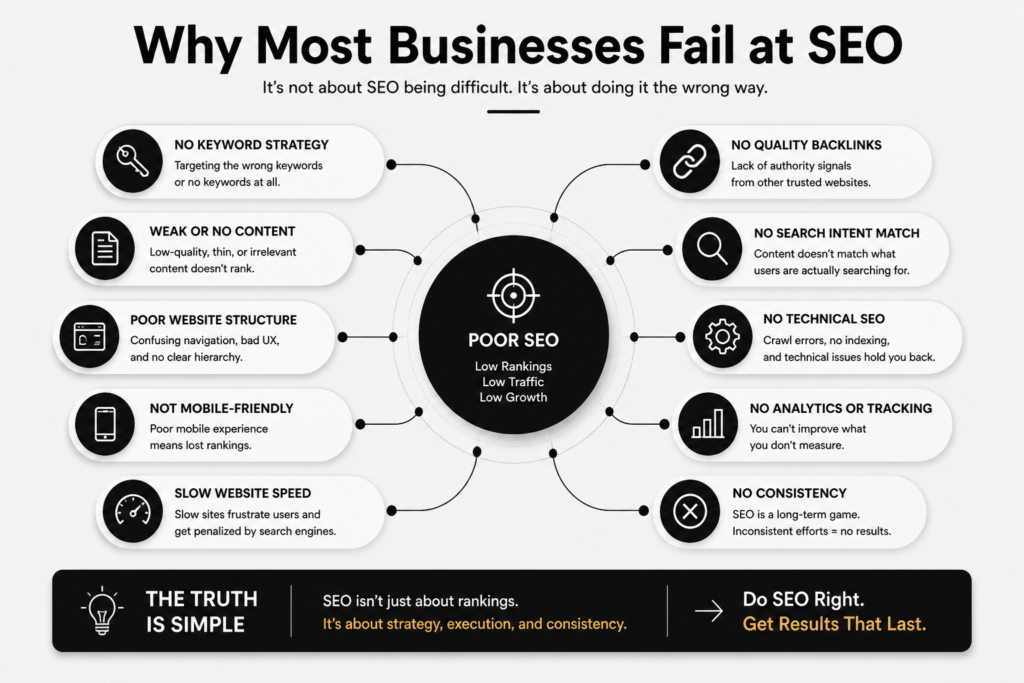
The failure is rarely technical.
It is strategic.
Common mistakes:
- Creating content without intent
- Targeting random keywords
- Ignoring website conversion
- Expecting fast results
- Treating SEO as a one-time task
SEO fails when it is treated as execution instead of a system.
What SEO Looks Like When Done Right
A structured SEO approach follows this sequence:
Research → Clarity → Systems → Growth → Execution
Research: Understand demand, keywords, intent
Clarity: Define positioning and message
Systems: Build content + site structure
Growth: Optimize and scale
Execution: Publish and refine consistently
This is where most businesses go wrong.
They start with execution.
If you want to go deeper:
- How long does SEO take to work
- SEO vs Paid Ads: Which is better
- Why SEO fails for businesses
- Digital Marketing Strategy Guide 2026
Final Perspective
SEO is not about ranking pages.
It is about positioning your business where demand already exists.
More content will not fix SEO.
More tools will not fix SEO.
More keywords will not fix SEO.
Structure will.
If you're trying to build SEO but it feels inconsistent, slow, or unclear the problem is not effort.It is structure.
If you want to build a system that actually drives growth, not just traffic



Recent Posts
- Modern Casino Technology and Its Impact on Player Experience at Superbet Online
- Pin Up Uzbekistan: Onlayn Kazino O‘yinlari va Bonuslar!
- Pin Up Casino: Azərbaycan onlayn oyun bazarında əyləncəli bir seçim
- Claim your rewards in Chicken Road 2: navigating the world of arcade gaming
- Шаг за шагом к выигрышу как Pinco casino поможет вам в азартных играх
Recent Comments
Search
Categories
- Digiital Marketing Strategy (1)
- Game (1)
- Games (1)
- public (16)
- SEO (1)
- Superbet Ελλάδα (1)
- Uncategorized (15)
3 Comments:
Robert Downey Jr
Lorem ipsum dolor sit amet, consectetur adipisicing elit, sed do eiusmod tempor incididunt ut labore et dolore magna aliqua. Atume nusaate staman utra phone limo sumeria.
Leona Porter
Duis aute irure dolor in reprehenderit in voluptate velit esse cillum dolore eu fugiat nulla pariatur. Excepteur sint occaecat cupidatat non proident.
Janie Blonde
Lorem ipsum dolor sit amet, consectetur adipisicing elit, sed do eiusmod tempor incididunt ut labore et dolore magna aliqua.